Art is a way to reclaim space and define boundaries when the body is constantly behaving unpredictably.
Despite being misdiagnosed with a trifecta of autoimmune diseases and recovering from the effects of the medication I took for two years, my body is still living with chronic illness: IBS and lingering gut issues resulting from gallbladder surgery seven years ago. These are often characterised as “invisible illnesses,” the kind where only the person living with them truly knows of their existence. To an onlooker, a person can appear perfectly healthy, but they do not see the constant internal struggle.
I knew of Yayoi Kusama, the famously eccentric artist from Japan, but I had no idea she had voluntarily checked herself into a psychiatric hospital upon returning to Tokyo after a whirlwind creative relationship with New York. Kusama has suffered from vivid hallucinations from a very young age. Fields of flowers, dots, patterns, and textures have come to life around her since childhood, as if she were living in a permanent, immersive exhibition. She turned her “invisible illness” into a powerful visual language of polka dots, infinity nets, provocative sculptures, installations, and mirror rooms, that demanded visibility and recognition.
Like Frida Kahlo, who used her art to chronicle her physical suffering and bodily fragility, Kusama created an infinite space for her and her neurosis to co-exist:
“Every time I have had a problem, I have confronted it with an ax of art.”
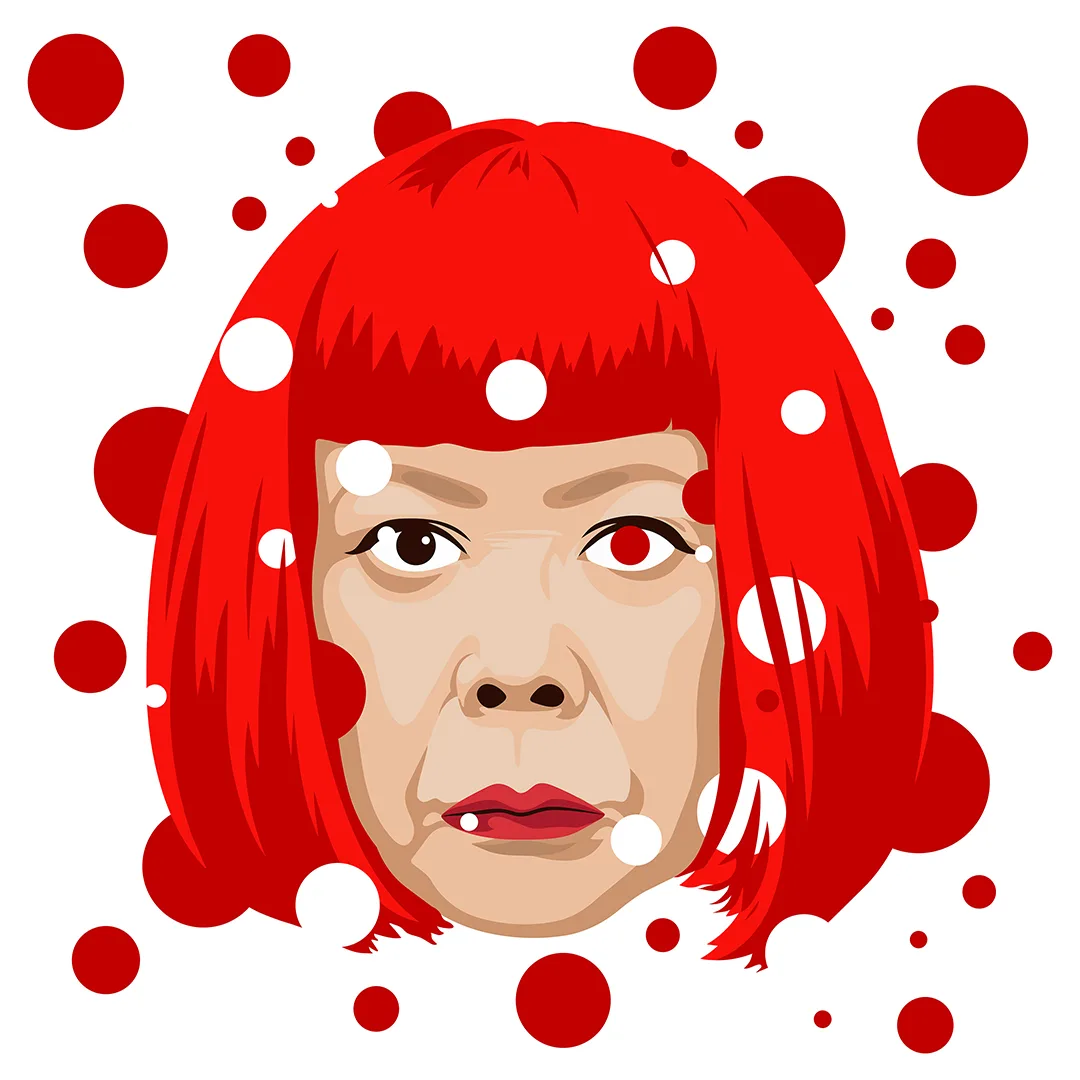
This realisation compelled me to create my homage portrait: Polka Dot Princess.
For me, this portrait felt different. Yayoi Kusama is a living artist who has navigated her life with incredible authenticity. Infinity Net: The Autobiography of Yayoi Kusama is a must-read, and it portrays her as she is: unapologetic and raw in her truth. That is exactly how she looks at us in my portrait.
I surrounded her with her beloved polka dots, drawing inspiration from my first Kusama experience: the painting My Life is a Dot Among Thousands of Other Dots, exhibited at the Moco Museum in Barcelona. I chose to render the colours in red and white to represent Japan and to mimic the palette she has used in her self-obliteration pieces. These contrasting colours are striking, perfectly complementing her hair colour as it is now and merging multiple aspects of her identity. I didn’t want to ground her by adding anything other than her face; instead, I wanted her to appear as if she were retreating and obliterating into the universe:
“…self-obliteration is the profound, sometimes terrifying, and liberating sensation of dissolving one’s ego into the infinite universe…”
For a while now, I have allowed my “invisible illness” to act as an excuse to think less of myself, often under the guise of imposter syndrome. But leaning into Kusama’s world has given me the courage to use my art as an antidote to the reality of my physical limitations. Where my body creates chaos, my blank canvas acts as stable ground, balanced and controlled in a way I yearn for my body to be, tuning out the internal noise of “you can’t do this.”
To me, Kusama is the ultimate architect of survival. Her work is a testament to the idea that if you can control the internal, you can master the external. However, my admiration comes with a boundary. I have struggled to look at some of her earlier works and her Accumulation series due to my own sensory aversions to particular textures and patterns. Yet, I did not let that stop me. I persevered, devouring everything I could find about Kusama whilst carefully navigating around the works that might trigger an unwanted reaction. I was in control.
I find myself gravitating towards artists with whom I can connect on a deeper level, not only for inspiration when I feel lost but to draw on the strength they demonstrate in knowing who they are. Each time I move a little closer to my own truth, it seeps into my work. Yayoi Kusama has had a profound impact in this regard. Despite her own “invisible illness” and her ongoing struggles, she remains a pioneer, a beacon of strength, and an icon who feels an abundance of love. She is art:
“I feel how truly wonderful life is, and I tremble with undying fascination for the world of art, the only place that gives me hope and makes life worthwhile. And no matter how I may suffer for my art, I will have no regrets. This is the way I have lived my life, and it is the way I shall go on living.”