“The importance of art is in the process of doing it, in the learning experience where the artist interacts with whatever is being made.”
Roy Lichtenstein
I came across this quote during a deep research dive into the life and work of Roy Lichtenstein, while preparing my next homage portrait. It perfectly reflects where I am right now in my artistic journey: fully immersed in the learning process. So much so, in fact, that Man Before A Mirror took its time revealing itself.
Roy Lichtenstein (1923–1997) was an American artist who became a leading figure in the Pop Art movement, challenging ideas of originality, fine art, and mass culture within the art world. After studying art, he served in the U.S. Army during the Second World War, then raised a family and worked as an art teacher at Ohio State University and Rutgers University. As a result, he entered the art scene relatively late. It was in the early 1960s, through his comic-inspired paintings and distinctive Ben-Day dot style, that he, alongside Andy Warhol, came to define Pop Art.
Lichtenstein’s work was one of my earliest and most influential sources of inspiration growing up. The simplicity, the clean, bold black lines, the powerful and unapologetic primary palette, and the impact of art viewed up close, zoomed in, left a lasting impression on me. That sense of intensity and immediacy played a huge role in shaping my approach to art and photography.
A true visual feast.
For this reason, I felt my portrait not only needed to pay homage to Lichtenstein, but also to embody his distinctive style. His Mirror series, alongside his self-portraits, both marked by deliberate detachment and the absence of self, became the foundation for the piece. This allowed my work to reintroduce the human presence, in this case Lichtenstein himself, creating a dialogue between perception, reflection, and identity.
He consistently omitted himself from his self-portraits in order to depersonalise the image, reinforcing the commercial and mechanical aspects of Pop Art. In contrast, I reintroduced him into the composition by centring and enclosing him within the oval mirror. This maintains the movement’s sense of detachment, as Lichtenstein remains suspended and disconnected from any surrounding reality, while simultaneously focusing on his face and gaze, an approach both Lichtenstein and Warhol employed. It is almost like a ‘missing person’ picture on a milk carton in 1980s America, objectifying an everyday image and elevating it to artistic status, again, a prominent characteristic of the Pop Art movement.
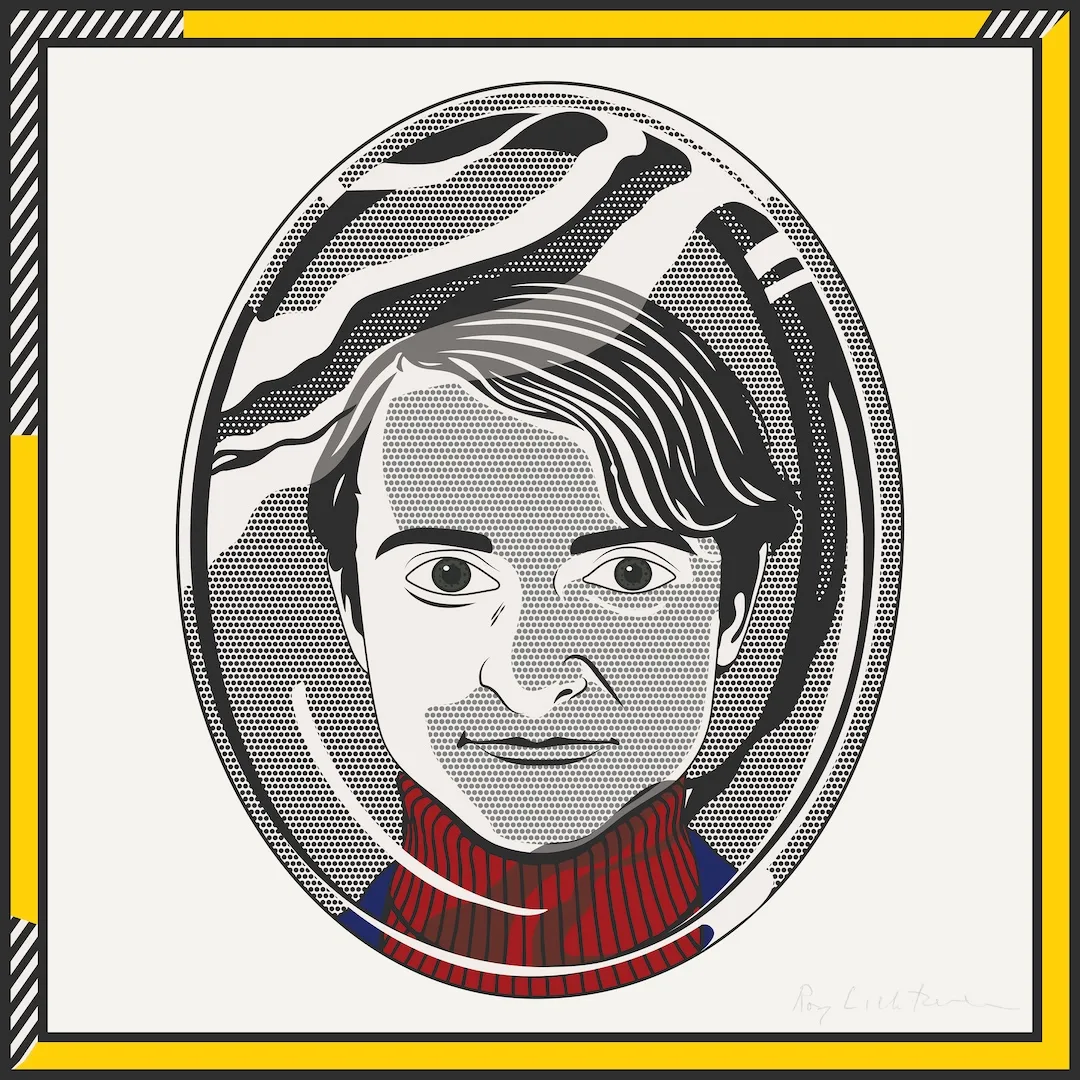
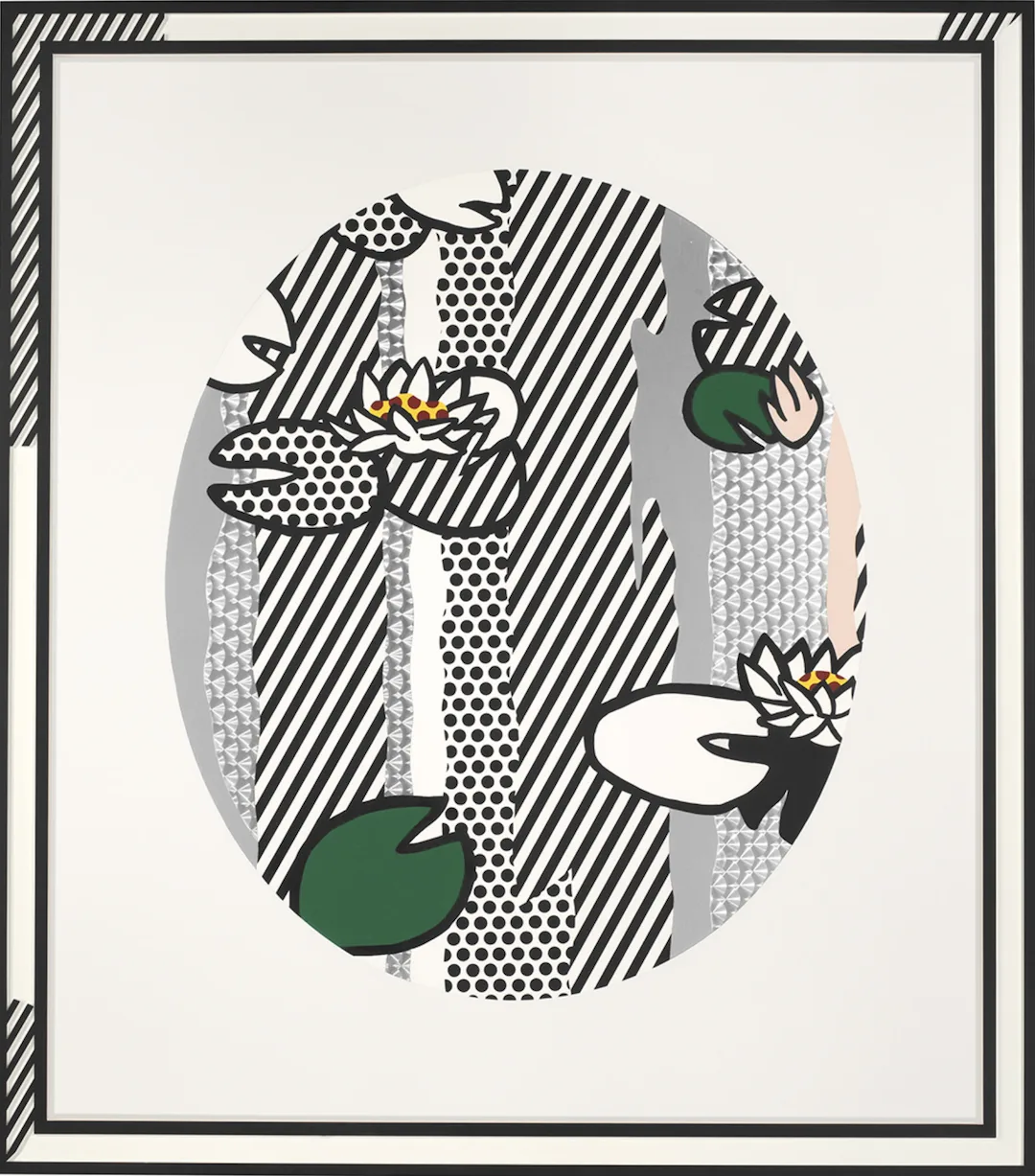
After recreating Lichtenstein’s Mirror No. 1 (1969), a process that was far from easy and still not exact (“I Could Do That!”) I chose to place the mirror within the frame of his Water Lilies, Pink Flower (1992), another work from his series of reinterpretations of Claude Monet’s iconic Impressionist subject. The frame serves as a nod to Lichtenstein’s long-standing fascination with Monet, and to my own fascination with Lichtenstein.
I kept the palette largely monochrome, with a single use of each primary colour for high visual impact, so as not to push Lichtenstein into the background. The red and blue of his clothing anchor his face within the composition, while the yellow frame pushes everything inward, drawing the viewer in.
Lichtenstein worked with such a distinct and consistent visual process throughout his career, combining unmatched technical precision with stylised artistry. His work became a cornerstone of visual communication. I wanted to honour that process by incorporating as many elements as possible: from diagonals and Ben-Day dots, to contrasts in line work. The reflective waves on the mirror pair with the waves of his hair, moving between clean lines and overall structure.
I believe I have achieved this. What do you think?